---
title: "How to Remove Stains from Sofa Fabric: A Guide for Charlotte Homeowners"
description: Learn how to remove sofa stains at home with professional tips for Charlotte homeowners. Treat wine, grease, and protein stains safely. When to call professionals.
image: https://hellovelvo.com/hubfs/how-to-remove-sofa-stains-charlotte-homeowners%20%281%29.webp
---
[Carpet](https://hellovelvo.com/carpet-cleaning) [Upholstery](https://hellovelvo.com/upholstery-cleaning) [Area Rugs](https://hellovelvo.com/area-rug-cleaning) [Commercial](https://hellovelvo.com/commercial-carpet-cleaning) [Blog](https://hellovelvo.com/blog) [About](https://hellovelvo.com/about)
[Text for a quote →](sms:+18434762925?body=Hi%20Velvo!%20I%20would%20like%20to%20get%20a%20free%20quote%20for%20cleaning.)
sofa stain removal · April 18, 2026 · 14 min read
# How to Remove Stains from Sofa Fabric: A Guide for Charlotte Homeowners
Paulo Sucesso
Owner · Velvo
.webp?width=2848&height=1504&name=how-to-remove-sofa-stains-charlotte-homeowners%20(1).webp)
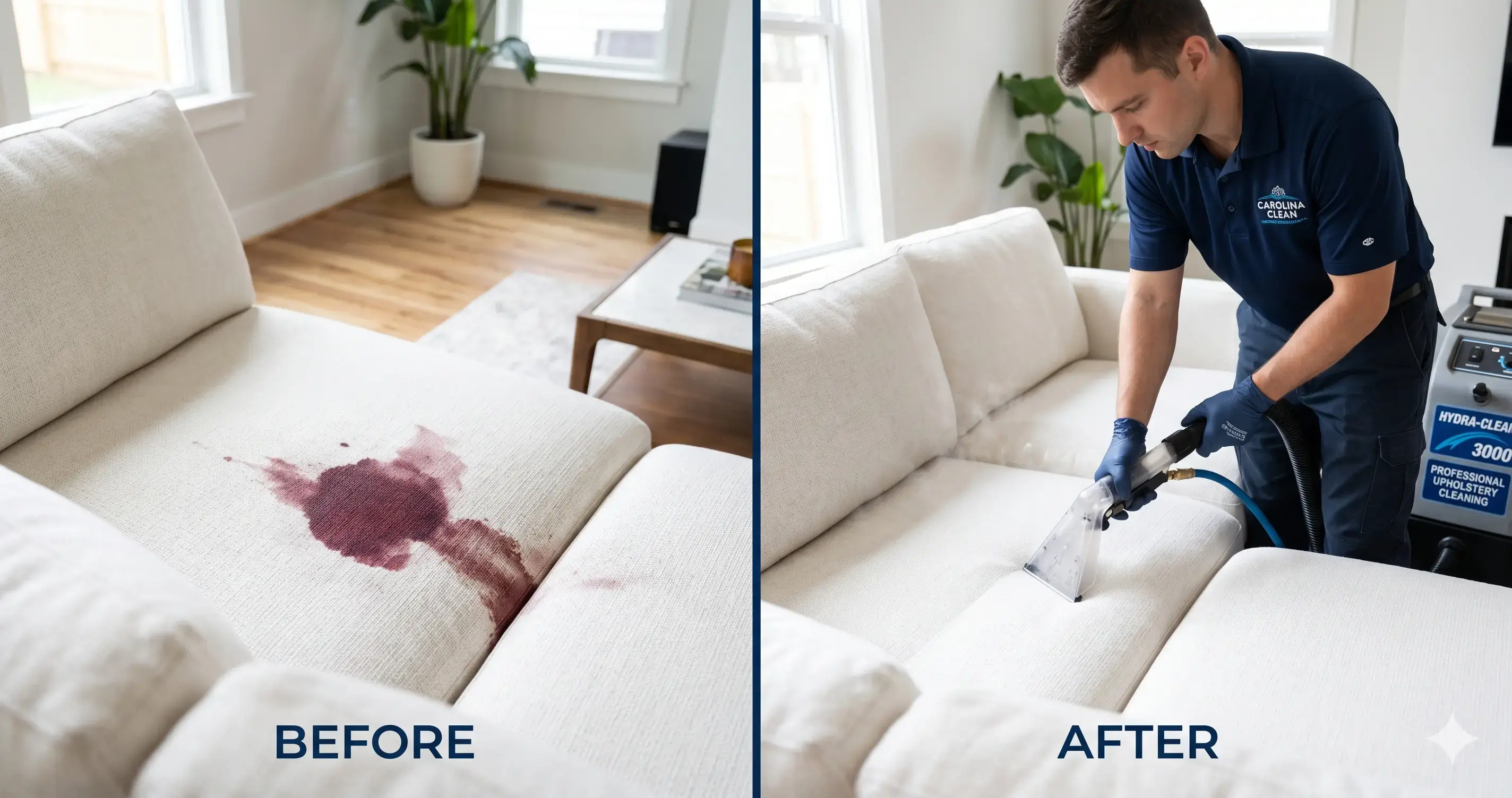
You notice it immediately: a wine glass tipped on your cream-colored sofa, juice splashed on the armrest, or a mysterious dark spot that wasn't there last week. Your first instinct? Panic. But here's what most Charlotte homeowners don't realize: many of these "permanent" stains can actually be removed—but only if you act quickly and use the right method for your fabric type.
The challenge isn't just the stain itself. It's understanding *what* you're treating and *how* to treat it without causing more damage. Apply heat to a protein stain, and you've made it permanent. Use water on the wrong fabric code, and you could end up with spotting that's worse than the original stain. Add Charlotte's humidity into the equation—where moisture can trap odors and slow drying—and the stakes get higher.
The good news? You don't need to panic or assume your sofa is ruined. This guide walks you through exactly how professionals approach sofa stains, when DIY methods work, and most importantly, when to call in professional help. For a comprehensive overview of upholstery care beyond stain removal, see our[complete upholstery cleaning guide](https://hellovelvo.com/blog/upholstery-cleaning-guide).
**Need professional upholstery stain removal in Charlotte?**[**Velvo specializes in deep fabric cleaning**](https://hellovelvo.com/upholstery-cleaning) **that removes tough stains, odors, and allergens from sofas and couches. We can often restore your furniture to like-new condition—even when home treatments haven't worked.**
## **Why Sofa Stains Happen (And Why They're Harder to Remove Than You Think)**
Before you start treating a stain, you need to understand what you're actually dealing with. Different stain types behave in completely different ways, and treating one like the other can lock the damage in permanently.
**Protein-based stains** (blood, dairy, eggs, bodily fluids) are deceptive. They may seem manageable at first, but here's the critical detail: heat sets them permanently. Apply hot water, and the protein bonds irreversibly to the fabric fibers—making removal nearly impossible. This is why hot water is often the worst first move.
**Oil and grease stains** (cooking splatters, lotion, sunscreen, skin oils) repel water, so traditional water-based cleaners often don't work. They slide right off without penetrating. This is also why these stains are notorious for *reappearing* after the sofa dries—the oil travels along the fibers and resurfaces when moisture evaporates. You can spend 30 minutes cleaning only to watch it come back within hours.
**Tannin stains** (wine, tea, coffee, juice) are plant-based and uniquely tricky. They can actually lighten or darken depending on what chemical treatment you use. Wine on light upholstery is particularly problematic because even after it appears completely clean, a brownish ghost stain sometimes reappears days later as the fabric fully dries.
**Combination stains** (chocolate, pasta sauce, spilled cocktails, ketchup) are the most common in real homes. They contain proteins, oils, and dyes simultaneously, which means they require a multi-step approach—you can't just use one solution and expect results.
Charlotte homes face an additional challenge that homeowners elsewhere don't: the combination of humidity and seasonal pollen. Our region's red clay soil and spring pollen leave residues on upholstery that trap moisture and create that sticky, grimy feeling on furniture that should be clean. When drying improves, humidity actually works against you—it slows evaporation and can make your sofa smell worse, while also creating ideal conditions for dust mites and allergens. This is why humidity-aware drying is just as important as the cleaning itself. The[Carpet and Rug Institute](https://carpet-rug.org/) recommends proper moisture management to prevent these issues.
## **Understanding Upholstery Codes: Your First Step to Safe Cleaning**
Before you reach for *any* cleaner, you need to know what your sofa can actually handle. Every upholstered piece comes with a care code—usually on a tag underneath the sofa or on the seam of a cushion. These codes tell you exactly which cleaning methods are safe and which ones could cause permanent damage.
Here's what you need to know:
- **W** = Water-based cleaners are safe (mild dish soap and water solutions)
- **S** = Solvent-based cleaners only (no water—these delicate fabrics will be damaged by moisture)
- **WS** = Either water or solvent-based cleaners work fine
- **X** = Dry cleaning or vacuuming only—water or chemicals will damage the fabric permanently
If you can't find the tag, do a hidden spot test before treating any visible area. Apply your cleaner to the bottom of a cushion or the back of the sofa where mistakes won't show.
**Microfiber upholstery** deserves special attention because it's extremely common in Charlotte homes and behaves completely differently from natural fabrics. Microfiber repels liquid initially—which seems helpful until you realize it also repels most cleaners. Even worse: water can cause permanent spotting on microfiber, and traditional soap-and-water solutions often leave residue that actually attracts more dirt. If you have microfiber, this section matters even more.
## **Practical Solutions: How to Remove Sofa Stains at Home**
The method you choose depends entirely on the stain type and your fabric code. Here's how professionals approach the most common scenarios:
### **For Fresh, Wet Stains (Act Within Minutes)**
Speed matters. The longer a wet stain sits, the deeper it penetrates, so act immediately:
**1. Blot immediately—don't rub.** Use a clean white cloth or paper towels and press down to absorb liquid. Rubbing spreads the stain deeper into the fibers and can cause damage. Work from the outside of the stain toward the center to prevent it from spreading outward.
**2. Skip heat entirely.** For protein-based stains especially, heat sets them permanently. Avoid hair dryers, heat lamps, or any direct heat source. Air drying at room temperature is always safest.
**3. Rinse with cold water (water-safe fabrics only).** For sofas with W or WS codes, blot with a cloth dampened in cold water. This removes some of the staining agent before it bonds to the fibers.
**4. Pull out moisture with towels.** Place a dry towel over the area and let it sit for several minutes to absorb remaining moisture from deep in the fabric. Repeat 2–3 times as needed. This step is crucial in Charlotte's humidity—the more moisture you remove now, the faster the sofa will dry.
### **For Dried or Set-In Stains**
Set-in stains require a different strategy because the stain has already begun bonding to the fibers:
**1. Vacuum thoroughly first.** Use an upholstery attachment to remove any dry material, dust, or debris. This prevents you from grinding particles into the fabric when you apply liquid cleaner—a common mistake that embeds the stain deeper.
**2. Identify the stain type if possible.** Knowing whether it's oil, protein, tannin, or a combination helps you choose the right cleaner and saves time.
**3. Mix a gentle cleaning solution (for water-safe fabrics):**
- 1 tablespoon of clear liquid dish soap (like Dawn)
- 1 cup of cold water
- 1 tablespoon of white vinegar (helps remove residue and odors)
Avoid laundry detergent or harsh soaps—these leave a film that attracts dirt and makes your sofa look dirty again within days.
**4. Test on a hidden area first.** Apply the solution to a small, inconspicuous spot (bottom of a cushion works well) and let it sit for 5 minutes. Blot with a white cloth. If the color doesn't change or run, it's safe to use on the visible stain.
**5. Apply cleaner directly to the stain—don't oversaturate.** A damp cloth is better than a soaking one. Let the cleaner sit for 5–10 minutes so it can break down the staining agent. Patience here makes a difference.
**6. Blot with a clean, damp cloth.** Use cold water to rinse away all soap residue. You may need to repeat the rinse step 2–3 times until the water comes away clear. **This step is critical:** leftover soap residue will attract dirt and make the area look dirty again within days. It's worth taking extra time here.
**7. Dry thoroughly—this matters in Charlotte.** Use towels to absorb as much moisture as possible, then allow the sofa to air dry completely. Open windows if weather permits, or use a fan to speed drying. Never cover the area with cushions or blankets until it's fully dry—trapped moisture causes mildew and odor.
### **For Oil and Grease Stains**
Water-based cleaners won't work on these, so a different approach is needed:
**1. Absorb fresh grease immediately with baking soda or cornstarch.** Sprinkle on the fresh stain and let it sit for 10–15 minutes to absorb oils before they set into the fibers. Vacuum thoroughly afterward.
**2. For set-in grease, use a dry solvent cleaner** (follow product instructions carefully and test on hidden areas first). Alternatively, rubbing alcohol diluted with water (1:1 ratio) can work on some fabrics, though always test first.
**3. Never use hot water on grease.** Heat liquefies the oil, making it spread further into the fabric—the opposite of what you want.
### **For Tannin Stains (Wine, Coffee, Tea, Juice)**
These stains are particularly tricky because they can resurface after drying:
**1. Blot immediately with cold water.** Don't delay—every minute counts with tannins.
**2. Mix equal parts white vinegar and water.** The acidity helps prevent the stain from setting permanently. This is more effective than water alone.
**3. Apply and blot repeatedly until the stain fades.** This may take several applications. Be patient and keep blotting.
**4. Rinse with plain cold water** to remove all vinegar (the smell is strong initially but dissipates completely as the sofa dries).
**5. Watch for ghost stains.** Even after tannin stains appear completely gone, they sometimes resurface faintly as the sofa dries. This is normal and usually fades with time or another gentle cleaning. Don't panic if you see this—it doesn't mean your cleaning failed.
## **When Professional Cleaning Is Your Best Option**
DIY methods work well for fresh, small stains on water-safe fabrics. But several situations clearly call for professional help, and knowing the difference can save your sofa from permanent damage or premature replacement.
**Deep or old stains** have bonded chemically to the fibers over time. They often require industrial extraction equipment and professional-grade cleaning solutions that homeowners simply don't have access to. Home blotting can't reach these—you need the deep penetration that professional equipment provides. Velvo's hot water extraction method can reach embedded stains that surface-level treatment never will.
**Delicate fabrics** (silk, velvet, natural wool) are high-risk for DIY. One wrong move—too much water, the wrong cleaner, or applying heat—can cause color bleeding, shrinkage, or permanent texture damage. These fabrics demand professional expertise.
**Large stains or multiple stains** across the sofa usually signal a deeper cleaning need. If your sofa has accumulated dirt, dust, and allergens over months or years, spot-treating individual stains won't address the overall problem. You end up with clean spots on a dirty sofa, which defeats the purpose.
**Stains that reappeared** after you cleaned them suggest moisture and soil are trapped deep in the padding or backing. This requires professional extraction to actually remove—not just push around. DIY methods can't reach these deep deposits.
**Mysterious stains** where you don't know what caused them require professional assessment. A trained upholstery technician can identify the stain type and recommend the safest treatment. Guessing wrong wastes time and risks damage.
**Fabric code X (dry clean only)?** Professional cleaning isn't optional—it's necessary. Attempting water-based cleaning on these fabrics causes permanent damage and may void your warranty.
## **Professional Upholstery Cleaning in Charlotte: When to Make the Call**
If you've tried home treatments without success, or if you're worried about damaging your sofa with DIY methods, professional upholstery cleaning removes stains that household methods simply can't touch. Here's what changes when you bring in the experts.
Velvo's technicians are trained in[IICRC standards](https://www.iicrc.org/) and understand exactly how different fabrics and stain types behave. Professional cleaning goes *beyond* stain removal—our process extracts embedded dust, pet dander, and allergens that accumulate deep in the cushions over months and years. Vacuum cleaners and spot treatments can never reach these deposits. In Charlotte homes, where humidity and pollen are constant factors, this deep cleaning helps your furniture stay fresher longer and supports better indoor air quality for your family.
We serve the entire Charlotte area, including nearby Fort Mill and Rock Hill, and we understand the specific climate challenges that our region presents for upholstered furniture. Whether your sofa needs a single large stain removed or a complete refresh, we have the equipment and expertise to restore it safely.
**Ready to restore your sofa to like-new condition? Schedule a professional upholstery cleaning appointment with Velvo. We serve**[**Charlotte and nearby Fort Mill and Rock Hill**](https://hellovelvo.com/upholstery-cleaning/charlotte)**. We'll assess your stains, recommend the best treatment approach based on your fabric type, and return your furniture looking and feeling fresh. Call or request a quote online today—let us handle the stains so you can enjoy your sofa again.**
## **FAQ: Sofa Stain Removal Questions**
**What's the difference between upholstery shampoo and professional extraction cleaning?**
Shampoos leave residue that attracts dirt and causes resoiling—you end up with a dirtier sofa weeks later. Professional hot water extraction removes both the stain *and* the cleaning solution through powerful suction, leaving your sofa truly clean. Extraction is also more effective on deep stains because it forces water and cleaning solution deep into the fibers, then removes all moisture—something home methods can't do.
**Can I use vinegar and baking soda on all sofa fabrics?**
These are gentler options than harsh chemicals, but they're not universal solutions. Always check your upholstery code first—vinegar can interact with certain dyes or finishes, and not all fabrics tolerate it. Baking soda is safe for most fabrics but doesn't work on oily stains. Test on a hidden area before treating any visible stains.
**How long does a sofa stain take to set permanently?**
It depends on the stain type. Protein-based stains can set within hours, especially if exposed to heat. Oil stains can sit for weeks before they truly set. Tannin stains often begin setting within 24–48 hours. The longer you wait, the harder removal becomes—so immediate action is always your best strategy.
**Will professional cleaning fade my sofa's color?**
No. Professional equipment uses hot water and controlled suction, not harsh chemicals or excessive scrubbing. When done correctly, extraction cleaning actually brightens colors by removing accumulated dirt and grime. We test all solutions on hidden areas first to ensure complete color safety.
**Can I clean my sofa myself after a professional cleaning?**
Absolutely. Between professional cleanings, spot-treat fresh spills immediately using the methods in this guide. For set-in stains between professional visits, use gentle spot-cleaning. Professional cleaning removes deep soil, but your regular care keeps it fresher longer.
---
**Your sofa doesn't have to stay stained.** Whether you handle it yourself or bring in the professionals, stains are removable—if you catch them early and use the right method. If home treatments haven't worked or you're concerned about damage, Velvo can help. We handle everything from fresh spills to years of accumulated dirt and staining.
**Contact us today for**[**upholstery cleaning in Charlotte, Fort Mill, or Rock Hill**](https://hellovelvo.com/upholstery-cleaning/charlotte)**.** Let's get your sofa looking its best again.
For more on keeping upholstery fresh between professional cleanings, check out our guide on[how often to clean upholstery](https://hellovelvo.com/blog/how-often-clean-upholstery) or learn more about[general fabric couch care](https://hellovelvo.com/blog/how-clean-fabric-couch).
---
*References:*
- *Institute of Inspection, Cleaning and Restoration Certification (IICRC). Professional upholstery cleaning standards.*
- *Carpet and Rug Institute. Fabric care and maintenance guidelines.*
[sofa stain removal](https://hellovelvo.com/blog/tag/sofa-stain-removal) [Charlotte upholstery cleaning](https://hellovelvo.com/blog/tag/charlotte-upholstery-cleaning) [how to remove sofa stains](https://hellovelvo.com/blog/tag/how-to-remove-sofa-stains) [professional sofa cleaning Charlotte](https://hellovelvo.com/blog/tag/professional-sofa-cleaning-charlotte) [Charlotte sofa stain removal](https://hellovelvo.com/blog/tag/charlotte-sofa-stain-removal) [how to remove wine stains from sofa fabric](https://hellovelvo.com/blog/tag/how-to-remove-wine-stains-from-sofa-fabric) [how to get grease out of sofa](https://hellovelvo.com/blog/tag/how-to-get-grease-out-of-sofa) [remove stains from sofa fabric](https://hellovelvo.com/blog/tag/remove-stains-from-sofa-fabric) [wine stain removal sofa](https://hellovelvo.com/blog/tag/wine-stain-removal-sofa) [DIY sofa cleaning](https://hellovelvo.com/blog/tag/diy-sofa-cleaning) [upholstery cleaning Charlotte SC](https://hellovelvo.com/blog/tag/upholstery-cleaning-charlotte-sc) [professional upholstery cleaning Charlotte NC](https://hellovelvo.com/blog/tag/professional-upholstery-cleaning-charlotte-nc) [upholstery cleaning tips Charlotte](https://hellovelvo.com/blog/tag/upholstery-cleaning-tips-charlotte) [grease stain removal sofa](https://hellovelvo.com/blog/tag/grease-stain-removal-sofa) [protein stain removal sofa](https://hellovelvo.com/blog/tag/protein-stain-removal-sofa) [best way to clean sofa stains](https://hellovelvo.com/blog/tag/best-way-to-clean-sofa-stains) [how to remove set-in stains from sofa](https://hellovelvo.com/blog/tag/how-to-remove-set-in-stains-from-sofa) [sofa stain removal at home](https://hellovelvo.com/blog/tag/sofa-stain-removal-at-home)
“The person on the phone is the person doing the job.”
[Text Paulo for an exact quote →](sms:+18434762925?body=Hi%20Paulo,%20I%27d%20like%20a%20quote.%20Can%20you%20help?)
Keep reading
## Related *articles.*
### [ upholstery cleaning Upholstery Cleaning in Rock Hill SC: A Homeowner's Guide to Cleaner Have you ever flipped a couch cushion and noticed the underside looks like a completely different color? That contrast ... Read →](https://hellovelvo.com/blog/upholstery-cleaning-rock-hill-homeowners-guide)
### [ upholstery cleaning Move Out Upholstery Cleaning in Fort Mill: How to Get Your Full Deposit Back Read →](https://hellovelvo.com/blog/move-out-upholstery-cleaning-fort-mill)
### [ upholstery cleaning How Often Should Upholstery Be Cleaned? A Practical Guide for Charlotte Homeowners Your sofa is probably one of the most-used pieces of furniture in your home. It's where the family gathers after ... Read →](https://hellovelvo.com/blog/how-often-clean-upholstery)
[← Previous How to Clean a Fabric Couch: The Complete Guide for Homeowners](https://hellovelvo.com/blog/how-clean-fabric-couch) [Next → How Often Should Upholstery Be Cleaned? A Practical Guide for Charlotte Homeowners](https://hellovelvo.com/blog/how-often-clean-upholstery)
"Clean enough to sit barefoot."
Book in 60 seconds
[Text for Quote](sms:+18434762925?body=Hi%20Velvo!%20I%20would%20like%20to%20get%20a%20free%20quote%20for%20cleaning.)
Or call — [(843) 476-2925](tel:+18434762925)
Services
- [Carpet cleaning](https://hellovelvo.com/carpet-cleaning)
- [Upholstery](https://hellovelvo.com/upholstery-cleaning)
- [Area rugs](https://hellovelvo.com/area-rug-cleaning)
- [Commercial](https://hellovelvo.com/commercial-carpet-cleaning)
Where we work
- Fort Mill SC
- Rock Hill SC
- Charlotte NC
- [All areas →](https://hellovelvo.com/areas-we-serve)
The company
- [About Paulo & Digiorgia](https://hellovelvo.com/about)
- [Our Story](https://hellovelvo.com/about/our-story)
- [Barefoot Clean Protocol™](https://hellovelvo.com/about/how-we-work)
- [Journal](https://hellovelvo.com/blog)
Reach us
- [(843) 476-2925](tel:+18434762925)
- [hello@hellovelvo.com](mailto:hello@hellovelvo.com)
- 510 Brafferton Pl, Fort Mill SC
- Mon–Fri 8a–9p · Sat 8a–2p
Follow
© 2026 Velvo LLC · Family-owned · Manaus → Fort Mill [Privacy](https://hellovelvo.com/privacy-policy) · [Terms](https://hellovelvo.com/terms-of-use)
```json
{
"@context" : "https://schema.org",
"@type" : "BlogPosting",
"author" : {
"@type" : "Person",
"name" : "Paulo Sucesso",
"url" : "https://hellovelvo.com/blog/author/paulo-sucesso"
},
"dateModified" : "2026-04-18T16:45:03.915Z",
"datePublished" : "2026-04-18T16:19:31.000Z",
"headline" : "How to Remove Stains from Sofa Fabric: A Guide for Charlotte Homeowners",
"image" : [ "https://hellovelvo.com/hubfs/how-to-remove-sofa-stains-charlotte-homeowners%20%281%29.webp" ],
"mainEntityOfPage" : {
"@id" : "https://hellovelvo.com/blog/remove-stains-from-sofa",
"@type" : "WebPage"
},
"publisher" : {
"@type" : "Organization",
"logo" : {
"@type" : "ImageObject",
"url" : "https://hellovelvo.com/hubfs/Logo-velvo-Wordmark.png"
},
"name" : "Velvo | Carpet And Upholstery Cleaning"
}
}
```
```json
{
"@context" : "https://schema.org",
"@id" : "https://hellovelvo.com/#localbusiness",
"@type" : "LocalBusiness",
"address" : {
"@type" : "PostalAddress",
"addressCountry" : "US",
"addressLocality" : "Fort Mill",
"addressRegion" : "SC",
"postalCode" : "29708",
"streetAddress" : "510 Brafferton Pl"
},
"aggregateRating" : {
"@type" : "AggregateRating",
"bestRating" : "5",
"ratingValue" : "5.0",
"reviewCount" : "20",
"worstRating" : "1"
},
"areaServed" : [ {
"@type" : "City",
"name" : "Charlotte"
}, {
"@type" : "City",
"name" : "Fort Mill"
}, {
"@type" : "City",
"name" : "Rock Hill"
} ],
"description" : "Professional carpet and upholstery cleaning services. Expert stain removal and deep cleaning serving Charlotte, NC, Fort Mill, SC, and surrounding areas.",
"geo" : {
"@type" : "GeoCoordinates",
"latitude" : 35.0346,
"longitude" : -80.9723
},
"image" : "https://hellovelvo.com/hubfs/Logo-velvo-Wordmark.png",
"name" : "Velvo | Carpet and Upholstery Cleaning",
"openingHoursSpecification" : [ {
"@type" : "OpeningHoursSpecification",
"closes" : "21:00",
"dayOfWeek" : [ "Monday", "Tuesday", "Wednesday", "Thursday", "Friday" ],
"opens" : "08:00"
}, {
"@type" : "OpeningHoursSpecification",
"closes" : "14:00",
"dayOfWeek" : [ "Saturday" ],
"opens" : "08:00"
} ],
"priceRange" : "$$",
"review" : [ {
"@type" : "Review",
"author" : {
"@type" : "Person",
"name" : "Angie Toth"
},
"datePublished" : "2026-06-01",
"itemReviewed" : {
"@type" : "LocalBusiness",
"name" : "Velvo | Carpet and Upholstery Cleaning"
},
"reviewBody" : "We had a great experience with Velvo. The team was professional, friendly, and arrived on time. They did an excellent job cleaning our carpets. The process was smooth and efficient. We highly recommend Velvo.",
"reviewRating" : {
"@type" : "Rating",
"bestRating" : "5",
"ratingValue" : "5"
}
}, {
"@type" : "Review",
"author" : {
"@type" : "Person",
"name" : "James Wright"
},
"datePublished" : "2026-05-12",
"itemReviewed" : {
"@type" : "LocalBusiness",
"name" : "Velvo | Carpet and Upholstery Cleaning"
},
"reviewBody" : "Great job, on time and polite did excellent work. I highly recommend Velvo carpet cleaning. He cleaned our carpets and couch. Just did an awesome job.",
"reviewRating" : {
"@type" : "Rating",
"bestRating" : "5",
"ratingValue" : "5"
}
}, {
"@type" : "Review",
"author" : {
"@type" : "Person",
"name" : "Carolina Acosta"
},
"datePublished" : "2026-04-21",
"itemReviewed" : {
"@type" : "LocalBusiness",
"name" : "Velvo | Carpet and Upholstery Cleaning"
},
"reviewBody" : "Thank you, Paulo - Velvo Carpet Cleaning, for your excellent work. You are kind, honest, and truly dedicated. My carpets look like new again. I highly recommend your services!",
"reviewRating" : {
"@type" : "Rating",
"bestRating" : "5",
"ratingValue" : "5"
}
}, {
"@type" : "Review",
"author" : {
"@type" : "Person",
"name" : "Jackie Raichandani"
},
"datePublished" : "2026-04-21",
"itemReviewed" : {
"@type" : "LocalBusiness",
"name" : "Velvo | Carpet and Upholstery Cleaning"
},
"reviewBody" : "They did an amazing job very professional.",
"reviewRating" : {
"@type" : "Rating",
"bestRating" : "5",
"ratingValue" : "5"
}
}, {
"@type" : "Review",
"author" : {
"@type" : "Person",
"name" : "M Houssman"
},
"datePublished" : "2026-04-07",
"itemReviewed" : {
"@type" : "LocalBusiness",
"name" : "Velvo | Carpet and Upholstery Cleaning"
},
"reviewBody" : "Velvo did a great job. Very good communication and pricing. They cleaned our carpet on the second floor and now it looks like new. No stains or odors!",
"reviewRating" : {
"@type" : "Rating",
"bestRating" : "5",
"ratingValue" : "5"
}
}, {
"@type" : "Review",
"author" : {
"@type" : "Person",
"name" : "Jessie Hollett"
},
"datePublished" : "2026-01-26",
"itemReviewed" : {
"@type" : "LocalBusiness",
"name" : "Velvo | Carpet and Upholstery Cleaning"
},
"reviewBody" : "We had a wonderful experience having our sectional couch cleaned with Velvo. Very kind and hardworking husband and wife team with heavy duty professional gear.",
"reviewRating" : {
"@type" : "Rating",
"bestRating" : "5",
"ratingValue" : "5"
}
}, {
"@type" : "Review",
"author" : {
"@type" : "Person",
"name" : "Elizabeth Lambert"
},
"datePublished" : "2026-01-26",
"itemReviewed" : {
"@type" : "LocalBusiness",
"name" : "Velvo | Carpet and Upholstery Cleaning"
},
"reviewBody" : "Paulo did an excellent job on our family room carpet and 2 upholstered chairs. He was very polite and very professional. I highly recommend him!",
"reviewRating" : {
"@type" : "Rating",
"bestRating" : "5",
"ratingValue" : "5"
}
}, {
"@type" : "Review",
"author" : {
"@type" : "Person",
"name" : "Jmatt17 M"
},
"datePublished" : "2026-01-19",
"itemReviewed" : {
"@type" : "LocalBusiness",
"name" : "Velvo | Carpet and Upholstery Cleaning"
},
"reviewBody" : "Carpets came out clean and fresh. Appreciate the hard work!",
"reviewRating" : {
"@type" : "Rating",
"bestRating" : "5",
"ratingValue" : "5"
}
}, {
"@type" : "Review",
"author" : {
"@type" : "Person",
"name" : "Nina Cymone"
},
"datePublished" : "2025-06-07",
"itemReviewed" : {
"@type" : "LocalBusiness",
"name" : "Velvo | Carpet and Upholstery Cleaning"
},
"reviewBody" : "Loved the service!",
"reviewRating" : {
"@type" : "Rating",
"bestRating" : "5",
"ratingValue" : "5"
}
}, {
"@type" : "Review",
"author" : {
"@type" : "Person",
"name" : "Starz Starz"
},
"datePublished" : "2025-04-30",
"itemReviewed" : {
"@type" : "LocalBusiness",
"name" : "Velvo | Carpet and Upholstery Cleaning"
},
"reviewBody" : "I had my carpets and staircases done today by Paulo. They did an excellent job. Everything looks brand new and smells fresh. I highly recommend them for your home!",
"reviewRating" : {
"@type" : "Rating",
"bestRating" : "5",
"ratingValue" : "5"
}
}, {
"@type" : "Review",
"author" : {
"@type" : "Person",
"name" : "Paloma Fontes"
},
"datePublished" : "2025-04-21",
"itemReviewed" : {
"@type" : "LocalBusiness",
"name" : "Velvo | Carpet and Upholstery Cleaning"
},
"reviewBody" : "Very good service and they are kind. I really recommend!",
"reviewRating" : {
"@type" : "Rating",
"bestRating" : "5",
"ratingValue" : "5"
}
}, {
"@type" : "Review",
"author" : {
"@type" : "Person",
"name" : "Henrique Bisneto"
},
"datePublished" : "2025-03-28",
"itemReviewed" : {
"@type" : "LocalBusiness",
"name" : "Velvo | Carpet and Upholstery Cleaning"
},
"reviewBody" : "Thank you for the excellent work on my home. I highly recommend it.",
"reviewRating" : {
"@type" : "Rating",
"bestRating" : "5",
"ratingValue" : "5"
}
}, {
"@type" : "Review",
"author" : {
"@type" : "Person",
"name" : "Elham Mori"
},
"datePublished" : "2024-12-30",
"itemReviewed" : {
"@type" : "LocalBusiness",
"name" : "Velvo | Carpet and Upholstery Cleaning"
},
"reviewBody" : "I couldn't be happier with the service I received from Paulo! They went above and beyond to make sure my carpets looked brand new. The team was punctual, professional, and incredibly thorough. They were able to remove stains I thought would never come out and left my home smelling fresh and clean. I highly recommend them to anyone looking for top-notch carpet cleaning.",
"reviewRating" : {
"@type" : "Rating",
"bestRating" : "5",
"ratingValue" : "5"
}
}, {
"@type" : "Review",
"author" : {
"@type" : "Person",
"name" : "Ram Mogili"
},
"datePublished" : "2024-11-23",
"itemReviewed" : {
"@type" : "LocalBusiness",
"name" : "Velvo | Carpet and Upholstery Cleaning"
},
"reviewBody" : "Paulo provided an excellent service, definitely recommend.",
"reviewRating" : {
"@type" : "Rating",
"bestRating" : "5",
"ratingValue" : "5"
}
}, {
"@type" : "Review",
"author" : {
"@type" : "Person",
"name" : "YH Wright"
},
"datePublished" : "2024-11-09",
"itemReviewed" : {
"@type" : "LocalBusiness",
"name" : "Velvo | Carpet and Upholstery Cleaning"
},
"reviewBody" : "I recently had the pleasure of using this carpet cleaning service for my home, and I can't recommend them highly enough! The booking process was incredibly straightforward. When the team arrived, they were punctual, professional, and well-equipped. My carpets, which had seen years of wear and tear, looked brand new. They tackled stubborn stains and odors with ease. I will definitely be using them again in the future!",
"reviewRating" : {
"@type" : "Rating",
"bestRating" : "5",
"ratingValue" : "5"
}
}, {
"@type" : "Review",
"author" : {
"@type" : "Person",
"name" : "Kate Duncan"
},
"datePublished" : "2024-11-07",
"itemReviewed" : {
"@type" : "LocalBusiness",
"name" : "Velvo | Carpet and Upholstery Cleaning"
},
"reviewBody" : "Very kind, professional, and reasonably priced father-and-son team. They responded quickly and did a fantastic job on our carpets! Highly recommend!",
"reviewRating" : {
"@type" : "Rating",
"bestRating" : "5",
"ratingValue" : "5"
}
}, {
"@type" : "Review",
"author" : {
"@type" : "Person",
"name" : "Gabriel Queiroz"
},
"datePublished" : "2024-10-23",
"itemReviewed" : {
"@type" : "LocalBusiness",
"name" : "Velvo | Carpet and Upholstery Cleaning"
},
"reviewBody" : "Velvo was one of the best experiences I've had with carpet cleaning. They are extremely detail-oriented. My apartment looks brand new. I highly recommend Velvo!",
"reviewRating" : {
"@type" : "Rating",
"bestRating" : "5",
"ratingValue" : "5"
}
}, {
"@type" : "Review",
"author" : {
"@type" : "Person",
"name" : "Cris Alberto"
},
"datePublished" : "2024-10-23",
"itemReviewed" : {
"@type" : "LocalBusiness",
"name" : "Velvo | Carpet and Upholstery Cleaning"
},
"reviewBody" : "The best carpet clean company ever. I was about to replace the carpet of my whole home and I decided to give it a chance and now my house smells fresh and clean and I save thousands of dollars. They are very professional and finish the service on time.",
"reviewRating" : {
"@type" : "Rating",
"bestRating" : "5",
"ratingValue" : "5"
}
}, {
"@type" : "Review",
"author" : {
"@type" : "Person",
"name" : "Susan"
},
"datePublished" : "2024-10-11",
"itemReviewed" : {
"@type" : "LocalBusiness",
"name" : "Velvo | Carpet and Upholstery Cleaning"
},
"reviewBody" : "These guys are the bomb! The carpet is like new and smells so good. They were prompt and courteous. Will definitely use them again!",
"reviewRating" : {
"@type" : "Rating",
"bestRating" : "5",
"ratingValue" : "5"
}
}, {
"@type" : "Review",
"author" : {
"@type" : "Person",
"name" : "Fabio Nolasco"
},
"datePublished" : "2024-10-11",
"itemReviewed" : {
"@type" : "LocalBusiness",
"name" : "Velvo | Carpet and Upholstery Cleaning"
},
"reviewBody" : "Very professional team and excellent prices! I highly recommend their services.",
"reviewRating" : {
"@type" : "Rating",
"bestRating" : "5",
"ratingValue" : "5"
}
} ],
"sameAs" : [ "https://www.instagram.com/hello.velvo/", "https://www.facebook.com/hello.velvo", "https://wa.me/18434762925", "https://www.linkedin.com/company/velvo", "https://nextdoor.com/page/velvo-carpet-and-upholstery-cleaning-fort-mill-sc", "https://x.com/HelloVelvo", "https://www.tiktok.com/@hello.velvo", "https://www.youtube.com/@hellovelvo", "https://www.pinterest.com/hellovelvo/", "https://www.threads.com/@hello.velvo", "https://share.google/EansHPzC1FQkYuDwz" ],
"telephone" : "+1-843-476-2925",
"url" : "https://hellovelvo.com/"
}
```
```json
{
"@context" : "https://schema.org",
"@id" : "https://hellovelvo.com/blog/remove-stains-from-sofa#howto",
"@type" : "HowTo",
"description" : "Step-by-step professional guide to removing fresh, set-in, oil, and tannin stains from sofa fabric",
"estimatedCost" : {
"@type" : "PriceSpecification",
"description" : "DIY methods use household items",
"price" : "0",
"priceCurrency" : "USD"
},
"image" : {
"@type" : "ImageObject",
"height" : 1504,
"url" : "https://hellovelvo.com/hubfs/how-to-remove-sofa-stains-charlotte-homeowners%20%281%29.webp",
"width" : 2848
},
"name" : "How to Remove Sofa Stains at Home",
"step" : [ {
"@type" : "HowToStep",
"name" : "Assess Your Fabric Code",
"position" : 1,
"text" : "Check the care code on your sofa (W, S, WS, or X). This determines which cleaning methods are safe for your specific upholstery."
}, {
"@type" : "HowToStep",
"name" : "For Fresh Stains: Blot Immediately",
"position" : 2,
"text" : "Use a clean white cloth and press down (don't rub) to absorb liquid. Work from outside the stain toward the center. Avoid heat at all costs."
}, {
"@type" : "HowToStep",
"name" : "For Set-In Stains: Vacuum First",
"position" : 3,
"text" : "Use upholstery attachment to remove dry debris. This prevents grinding particles into the fabric when you apply liquid cleaner."
}, {
"@type" : "HowToStep",
"name" : "Mix Gentle Cleaning Solution",
"position" : 4,
"text" : "Combine 1 tablespoon clear dish soap, 1 cup cold water, and 1 tablespoon white vinegar. Test on hidden area first."
}, {
"@type" : "HowToStep",
"name" : "Apply Cleaner and Blot",
"position" : 5,
"text" : "Apply solution without oversaturating. Let sit 5-10 minutes. Blot with clean damp cloth. Repeat rinse 2-3 times until water is clear."
}, {
"@type" : "HowToStep",
"name" : "Dry Thoroughly",
"position" : 6,
"text" : "Use towels to absorb moisture. Air dry completely. Open windows or use fans. Never cover with cushions until fully dry to prevent mildew."
} ],
"supply" : [ {
"@type" : "HowToSupply",
"name" : "White cloth or paper towels"
}, {
"@type" : "HowToSupply",
"name" : "Cold water"
}, {
"@type" : "HowToSupply",
"name" : "Clear liquid dish soap"
}, {
"@type" : "HowToSupply",
"name" : "White vinegar"
}, {
"@type" : "HowToSupply",
"name" : "Dry towels"
} ],
"tool" : [ {
"@type" : "HowToTool",
"name" : "Upholstery vacuum attachment"
}, {
"@type" : "HowToTool",
"name" : "White cloth (non-dyed)"
} ],
"totalTime" : "PT30M"
}
```
```json
{
"@context" : "https://schema.org",
"@id" : "https://hellovelvo.com/blog/remove-stains-from-sofa#faq",
"@type" : "FAQPage",
"mainEntity" : [ {
"@type" : "Question",
"acceptedAnswer" : {
"@type" : "Answer",
"text" : "Shampoos leave residue that attracts dirt and causes resoiling. Professional hot water extraction removes both the stain and the cleaning solution through powerful suction, leaving your sofa truly clean. Extraction is also more effective on deep stains because it forces water and cleaning solution deep into the fibers, then removes all moisture."
},
"name" : "What's the difference between upholstery shampoo and professional extraction cleaning?"
}, {
"@type" : "Question",
"acceptedAnswer" : {
"@type" : "Answer",
"text" : "These are gentler options than harsh chemicals, but they're not universal solutions. Always check your upholstery code first—vinegar can interact with certain dyes or finishes. Baking soda is safe for most fabrics but doesn't work on oily stains. Test on a hidden area before treating any visible stains."
},
"name" : "Can I use vinegar and baking soda on all sofa fabrics?"
}, {
"@type" : "Question",
"acceptedAnswer" : {
"@type" : "Answer",
"text" : "It depends on the stain type. Protein-based stains can set within hours, especially if exposed to heat. Oil stains can sit for weeks before they truly set. Tannin stains often begin setting within 24–48 hours. The longer you wait, the harder removal becomes—so immediate action is always your best strategy."
},
"name" : "How long does a sofa stain take to set permanently?"
}, {
"@type" : "Question",
"acceptedAnswer" : {
"@type" : "Answer",
"text" : "No. Professional equipment uses hot water and controlled suction, not harsh chemicals or excessive scrubbing. When done correctly, extraction cleaning actually brightens colors by removing accumulated dirt and grime. We test all solutions on hidden areas first to ensure complete color safety."
},
"name" : "Will professional cleaning fade my sofa's color?"
}, {
"@type" : "Question",
"acceptedAnswer" : {
"@type" : "Answer",
"text" : "Absolutely. Between professional cleanings, spot-treat fresh spills immediately using the methods in this guide. For set-in stains between professional visits, use gentle spot-cleaning. Professional cleaning removes deep soil, but your regular care keeps it fresher longer."
},
"name" : "Can I clean my sofa myself after a professional cleaning?"
} ]
}
```
```json
{
"@context" : "https://schema.org",
"@id" : "https://hellovelvo.com/blog/remove-stains-from-sofa#article",
"@type" : "Article",
"author" : {
"@type" : "Organization",
"name" : "Velvo",
"url" : "https://hellovelvo.com"
},
"dateModified" : "2026-04-18T16:33:38Z",
"datePublished" : "2026-04-18T16:19:31Z",
"description" : "Step-by-step professional guide to removing sofa stains safely from different fabric types",
"headline" : "How to Remove Stains from Sofa Fabric: A Guide for Charlotte Homeowners",
"image" : {
"@type" : "ImageObject",
"height" : 1504,
"url" : "https://hellovelvo.com/hubfs/how-to-remove-sofa-stains-charlotte-homeowners%20%281%29.webp",
"width" : 2848
},
"mentions" : [ {
"@type" : "Organization",
"name" : "Institute of Inspection, Cleaning and Restoration Certification",
"sameAs" : "https://www.iicrc.org",
"url" : "https://www.iicrc.org"
}, {
"@type" : "Organization",
"name" : "Carpet and Rug Institute",
"sameAs" : "https://carpet-rug.org",
"url" : "https://carpet-rug.org"
} ],
"publisher" : {
"@type" : "Organization",
"logo" : {
"@type" : "ImageObject",
"url" : "https://hellovelvo.com/hs-fs/hubfs/Logo%20Velvo%20180x75%20png.png"
},
"name" : "Velvo"
}
}
```