---
title: "Upholstery Cleaning in Rock Hill SC: A Homeowner's Guide to Cleaner"
description: Upholstery cleaning in Rock Hill SC — maintain your furniture, know when DIY falls short, and see how Velvo removes deep dirt, allergens, and pet odors.
image: https://hellovelvo.com/hubfs/AI-Generated%20Media/Images/Cozy%20Living%20Room%20with%20Fluffy%20Cat%20and%20Pastel%20Walls-1.png
---
[Carpet](https://hellovelvo.com/carpet-cleaning) [Upholstery](https://hellovelvo.com/upholstery-cleaning) [Area Rugs](https://hellovelvo.com/area-rug-cleaning) [Commercial](https://hellovelvo.com/commercial-carpet-cleaning) [Blog](https://hellovelvo.com/blog) [About](https://hellovelvo.com/about)
[Text for a quote →](sms:+18434762925?body=Hi%20Velvo!%20I%20would%20like%20to%20get%20a%20free%20quote%20for%20cleaning.)
upholstery cleaning · May 12, 2026 · 12 min read
# Upholstery Cleaning in Rock Hill SC: A Homeowner's Guide to Cleaner
Paulo Sucesso
Owner · Velvo
Have you ever flipped a couch cushion and noticed the underside looks like a completely different color? That contrast isn't just wear — it's a snapshot of everything your upholstery has absorbed while you weren't looking.
Your sofa handles more daily traffic than almost any other surface in your home. Movie nights, afternoon naps, kids scrambling over the armrests, pets staking out their favorite spot — the fabric quietly absorbs all of it. And unlike countertops or hardwood floors, you can't just wipe upholstery down and walk away.
For homeowners in Rock Hill, SC, the problem runs deeper than normal use. York County's humid summers push moisture into upholstery fibers, feeding mildew growth and musty smells that linger. Red clay — the unofficial soil of the Carolinas — tracks inside on shoes and pet paws, settling into fabric weaves where it dulls colors and resists vacuuming. Layer in pet dander and South Carolina's aggressive pollen seasons, and your furniture becomes an allergen reservoir without showing a single visible stain.
This guide covers what actually works for keeping upholstered furniture clean at home, how to tell when DIY methods have hit their limit, and what to expect from professional upholstery cleaning in Rock Hill SC.
---
**Dealing with dingy furniture or stubborn odors you can't seem to fix?** [Velvo's professional upholstery cleaning in Rock Hill](https://hellovelvo.com/upholstery-cleaning/rock-hill) removes deep-set dirt, allergens, and pet odors that household cleaning can't reach — restoring both the look and freshness of your furniture.
---
## Why Upholstery Gets Dirty Faster Than You Think
Most homeowners assume their furniture is relatively clean as long as there aren't visible stains. That assumption is misleading — and it's one of the main reasons upholstery deteriorates faster than it should.
Upholstery fabric acts like a filter. Every time someone sits down, body oils, sweat, dead skin cells, and whatever was on their clothing transfer into the fibers. Dust settles between cushions. Pet hair works its way into the weave. These layers build on each other week after week, compacting under the weight and friction of daily use.
What makes it worse in the Rock Hill area specifically?
- **Humidity.** South Carolina's warm, humid climate means upholstery retains moisture longer than in drier regions. That trapped moisture bonds with dust and body oils, creating a sticky residue deep inside the fabric that vacuuming alone can't break up.
- **Pollen cycles.** The Carolinas share some of the most aggressive pollen seasons in the Southeast. Fine pollen particles land on furniture surfaces and get pressed into the fabric every time someone sits down — gradually embedding where a lint roller or cloth can't reach.
- **Red clay soil.** Anyone living in York County knows this one. Red clay is iron-rich and bonds chemically with fabric dyes, making it one of the most stubborn stain sources for upholstery. Even trace amounts tracked indoors on shoes or pet paws can leave a dull, reddish discoloration on lighter fabrics over time.
According to the [Carpet and Rug Institute](https://carpet-rug.org/), upholstered furniture can harbor dust mites, bacteria, and allergens that accumulate gradually — with professional cleaning capable of removing up to 90% of the common allergens embedded in fabric.
## What Every Rock Hill Homeowner Should Know About Upholstery Fabrics
Not all upholstery cleans the same way, and using the wrong method on the wrong fabric is one of the most common — and costly — mistakes homeowners make. Before you reach for a bottle of spot cleaner, check the care tag on your furniture. That small label tells you exactly what the manufacturer recommends, and ignoring it can cause permanent damage.
### Understanding Cleaning Codes
Most upholstered furniture comes with a cleaning code stitched into the cushion or frame:
- **W** — Water-based cleaners are safe to use.
- **S** — Solvent-based cleaners only. Water can cause water marks, shrinkage, or texture changes.
- **WS** — Either water-based or solvent-based cleaners will work.
- **X** — Vacuum only. No liquid cleaners of any kind.
Microfiber upholstery — one of the most popular fabric choices in Rock Hill SC homes — typically falls under the "S" or "WS" category. Using water on an S-coded microfiber sofa is a common misstep that can leave visible water rings surprisingly difficult to remove without professional treatment.
### Fabric-Specific Concerns
Different materials react differently to cleaning products and techniques. Cotton and linen blends absorb spills fast and stain easily, making quick response critical. Polyester and synthetic blends resist staining better but tend to trap odors more readily — a real issue in homes with pets. Leather and faux leather need dedicated products entirely; standard upholstery cleaners can strip their protective finish and leave the surface dry or cracked.
If you're unsure about [how to clean a fabric couch](https://hellovelvo.com/blog/how-clean-fabric-couch) safely, testing any cleaner on a hidden area first isn't optional. It's the only way to avoid a mistake you can't undo.
## Practical Steps for Routine Upholstery Maintenance
Consistent maintenance extends the life of your furniture and reduces how often deep cleaning is needed. These are the steps that actually move the needle — not just for appearance, but for the air quality in your home:
1. **Vacuum weekly with an upholstery attachment.** Use the crevice tool along seams and between cushions where crumbs, pet hair, and dust collect. A standard vacuum head doesn't generate enough targeted suction for fabric fibers — the upholstery-specific attachment makes a measurable difference in what gets pulled out.
2. **Rotate and flip cushions every two weeks.** This distributes wear and body compression evenly, preventing one side from becoming permanently flattened or discolored. It takes 30 seconds and pays off noticeably within a few months.
3. **Blot spills immediately — never rub.** Rubbing pushes liquid deeper into the fabric and spreads the stain outward. Press a clean white cloth firmly into the spill, lift, and repeat. Always work from the outside of the stain inward to keep it contained.
4. **Use baking soda for odor control between cleanings.** Sprinkle a light, even layer over the fabric, let it sit for 15–20 minutes, then vacuum it up thoroughly. This works well for mild pet odors and general mustiness — both common in Rock Hill homes during the more humid months. It won't solve deep odor problems, but it's effective maintenance between professional cleanings.
5. **Keep furniture out of direct sunlight.** UV exposure fades fabric dyes unevenly, especially on cotton and linen blends. If repositioning isn't realistic, window treatments or UV-protective film help slow the damage.
These habits handle surface-level upkeep well. But they won't reach what's compacted deeper in the fabric and padding — and that's where the line between maintenance and professional cleaning becomes clear. For a more detailed schedule tailored to different household situations, check out this guide on [how often you should clean upholstery](https://hellovelvo.com/blog/how-often-clean-upholstery).
## When Professional Upholstery Cleaning Is Worth It
DIY methods have a ceiling, and most homeowners hit it sooner than they realize. Vacuuming removes loose surface debris. Spot cleaning handles fresh spills. Baking soda manages mild odors. But none of these approaches extract the compacted grime, allergens, and oils that settle deep inside upholstery fibers over months and years of daily use.
So how do you know when it's time to go beyond what you can do yourself?
**Visible wear patterns.** If the spots where people sit most often look noticeably darker or flatter than the rest of the piece, surface dirt has been ground into the fiber structure. At this point, no amount of vacuuming or spot treatment will restore the original look — the soil is physically embedded, not just sitting on the surface.
**Persistent odors.** A sofa that still smells after you've cleaned it is telling you the source is below the surface layer. Pet urine, accumulated body oils, and mildew can saturate the padding underneath the fabric — well beyond where any spray or powder can reach. Steam upholstery cleaning and hot water extraction are specifically designed to flush contaminants from deep within the cushion structure. If pet odors are a recurring battle, this guide on [removing pet odor from upholstery](https://hellovelvo.com/blog/remove-pet-odor-upholstery) breaks down why surface treatments fall short.
**Allergy symptoms that worsen at home.** Dust mites thrive in upholstery, and their waste is one of the most common triggers for indoor allergies. If someone in your household sneezes or experiences congestion more at home than anywhere else, your furniture may be a contributing factor that's easy to overlook.
**It's been over 12–18 months since the last deep clean.** The [IICRC](https://www.iicrc.org/) (Institute of Inspection, Cleaning and Restoration Certification) recommends professional upholstery cleaning at least once a year for homes with regular use — and every 6 to 9 months for households with pets or young children.
---
**Here's the reality: once dirt, allergens, and odors are embedded in the padding and deep fibers of your furniture, no amount of surface cleaning will get them out.** That's exactly what professional hot water extraction is built to solve. Velvo's upholstery cleaning process flushes out what's trapped below the surface — removing allergens, eliminating odor sources, and restoring the look and feel of your furniture. If your couch hasn't had a professional cleaning in over a year, this is the step that makes the biggest difference. [Schedule your upholstery cleaning in Rock Hill →](https://hellovelvo.com/upholstery-cleaning/rock-hill)
---
## Professional Upholstery Cleaning Services in Rock Hill
Finding a reliable sofa cleaning service in Rock Hill SC shouldn't require guesswork. But not every company uses the same methods or delivers the same results, so knowing what to look for matters.
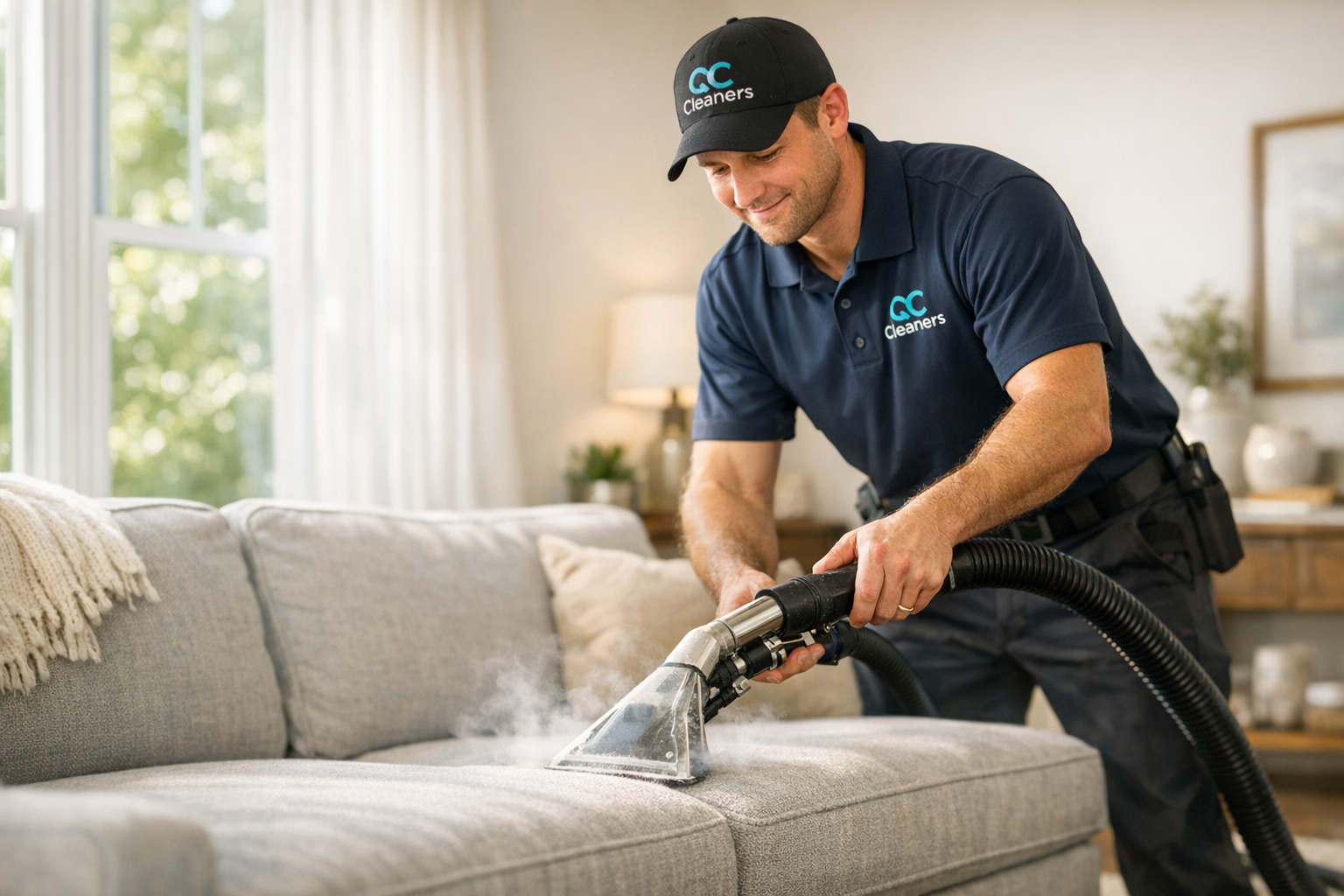
The gold standard for upholstery cleaning is hot water extraction — sometimes called steam cleaning, though the two aren't identical. Hot water extraction injects a heated cleaning solution into the fabric under controlled pressure, then immediately extracts it along with loosened dirt, allergens, oils, and residue. It's the method recommended by most upholstery manufacturers and endorsed by industry organizations like the IICRC because it cleans deep without leaving behind excess moisture or chemical residue that can attract new soil.
Some providers rely on dry cleaning or encapsulation methods, which can work for light maintenance but don't penetrate deep enough for a true restorative clean — especially on heavily used or pet-affected furniture.
Velvo provides [professional upholstery cleaning](https://hellovelvo.com/upholstery-cleaning) throughout Rock Hill and the surrounding York County area, including Fort Mill and Charlotte. Every job begins with a fabric assessment to identify the material type, cleaning code, and any problem areas — so the approach is matched to your specific furniture, not a one-size-fits-all treatment. Whether you're dealing with deep-set stains, embedded pet hair, or a sofa that just doesn't look or smell the way it used to, professional-grade extraction delivers results that household methods can't replicate.
For homeowners who want a deeper understanding of cleaning methods, fabric types, and long-term maintenance strategies, the [complete upholstery cleaning guide](https://hellovelvo.com/blog/upholstery-cleaning-guide) covers everything in detail.
---
**Your furniture should feel as clean as it looks.** [Request a free quote from Velvo](https://hellovelvo.com/upholstery-cleaning/rock-hill) for professional upholstery cleaning in Rock Hill SC — and give your home's most-used surfaces the deep clean they've been missing.
---
## Frequently Asked Questions About Upholstery Cleaning in Rock Hill SC
### How much does professional upholstery cleaning cost in Rock Hill SC?
Pricing depends on the size of the piece, fabric type, and current condition. A standard sofa cleaning typically costs a fraction of replacing cushion covers or buying a new couch — making it one of the most cost-effective ways to extend the life of furniture you already own. Velvo offers free quotes so you know the exact cost before scheduling.
### Is professional upholstery cleaning worth it, or should I just rent a machine and do it myself?
Rental machines lack the suction power to extract moisture properly, which can leave fabric damp for days and even lead to mold or mildew growth inside the cushions. Professional equipment deep-cleans and dries upholstery in a fraction of the time while protecting delicate fabrics from water rings, color bleeding, and texture damage that DIY attempts often cause. For anything beyond a quick spot-clean on durable polyester, professional cleaning pays for itself in results and risk avoidance.
### How long does it take for upholstery to dry after professional cleaning?
With hot water extraction, most upholstery dries within 4 to 8 hours. Drying time varies based on fabric density, humidity levels, and airflow in the room. Running a fan or opening windows helps speed things up — especially useful during Rock Hill's humid summer months when ambient moisture slows evaporation.
### Can professional cleaning remove pet stains and odors from a couch?
Yes. Professional-grade hot water extraction reaches deep into the fabric and padding where pet urine and odor-causing bacteria settle — the layers that surface sprays and powders can't access. Extraction removes the source of the odor, not just the smell. Heavily saturated areas may need a specialized enzyme treatment for full elimination, but most pet odor issues resolve with a single professional cleaning.
### How often should I have my upholstery professionally cleaned?
For most Rock Hill SC homes, once a year is a reliable starting point. Households with pets, young children, or allergy sufferers benefit from cleaning every 6 to 9 months. The IICRC recommends annual professional cleaning as the minimum standard for maintaining fabric integrity, appearance, and indoor air quality.
### Will professional cleaning damage or shrink my fabric?
Not when the technician follows proper protocol. Before any cleaning begins, the fabric's care tag is inspected — W (water-safe), S (solvent-only), WS (either method), or X (vacuum only). Water-safe fabrics get hot water extraction; solvent-only fabrics get a low-moisture dry-cleaning process. A hidden area is tested first on any unfamiliar fabric. This pre-inspection step is what prevents shrinkage, color bleeding, and texture damage.
### What's the difference between steam cleaning and dry cleaning for upholstery?
Steam cleaning — technically hot water extraction — injects heated water and cleaning solution deep into the fabric, then extracts it along with embedded dirt and allergens. It delivers the most thorough results on durable fabrics like polyester, microfiber, and cotton blends. Dry cleaning uses a low-moisture chemical solvent and is the safer choice for delicate materials like silk, rayon, or vintage upholstery. The right method depends on the fabric's care code, not personal preference.
### Do I need to move my furniture or prepare anything before the cleaning appointment?
No heavy lifting required. Remove personal items like throw pillows, blankets, and anything stored under or between cushions. Clearing a small path from the door to the furniture helps the technician move equipment in efficiently. Protective pads are placed under and around each piece to keep your floors clean and dry during the process.
### Can you clean outdoor cushions and patio furniture fabric?
Yes. Outdoor cushions collect mold, mildew, pollen, and UV-degraded sunscreen residue that regular hosing doesn't remove. Professional cleaning restores Sunbrella and similar solution-dyed acrylic fabrics and helps prevent mildew from returning — which matters in Rock Hill's warm, humid climate where outdoor furniture stays exposed most of the year.
### Do you offer any guarantee if the stains don't come out?
Velvo is upfront about what to expect. Most stains respond well to professional treatment, but some — like bleach marks, permanent dye transfers, or old set-in stains — are chemical changes in the fiber that no cleaning method can reverse. During the initial inspection, the technician identifies which stains are expected to come out and which may only improve. If a result falls short of what was promised, the area is re-treated at no additional charge.
[upholstery cleaning](https://hellovelvo.com/blog/tag/upholstery-cleaning) [professional upholstery cleaning](https://hellovelvo.com/blog/tag/professional-upholstery-cleaning) [hot water extraction](https://hellovelvo.com/blog/tag/hot-water-extraction) [couch cleaning](https://hellovelvo.com/blog/tag/couch-cleaning) [sofa cleaning](https://hellovelvo.com/blog/tag/sofa-cleaning) [pet odor removal](https://hellovelvo.com/blog/tag/pet-odor-removal) [Rock Hill SC](https://hellovelvo.com/blog/tag/rock-hill-sc) [upholstery maintenance](https://hellovelvo.com/blog/tag/upholstery-maintenance) [upholstery care tips](https://hellovelvo.com/blog/tag/upholstery-care-tips) [pet hair removal](https://hellovelvo.com/blog/tag/pet-hair-removal) [fabric cleaning](https://hellovelvo.com/blog/tag/fabric-cleaning) [steam cleaning](https://hellovelvo.com/blog/tag/steam-cleaning) [allergen removal](https://hellovelvo.com/blog/tag/allergen-removal) [York County](https://hellovelvo.com/blog/tag/york-county) [microfiber cleaning](https://hellovelvo.com/blog/tag/microfiber-cleaning)
“The person on the phone is the person doing the job.”
[Text Paulo for an exact quote →](sms:+18434762925?body=Hi%20Paulo,%20I%27d%20like%20a%20quote.%20Can%20you%20help?)
Keep reading
## Related *articles.*
### [ upholstery cleaning Move Out Upholstery Cleaning in Fort Mill: How to Get Your Full Deposit Back Read →](https://hellovelvo.com/blog/move-out-upholstery-cleaning-fort-mill)
### [ upholstery cleaning How Often Should Upholstery Be Cleaned? A Practical Guide for Charlotte Homeowners Your sofa is probably one of the most-used pieces of furniture in your home. It's where the family gathers after ... Read →](https://hellovelvo.com/blog/how-often-clean-upholstery)
[← Previous Move Out Upholstery Cleaning in Fort Mill: How to Get Your Full Deposit Back](https://hellovelvo.com/blog/move-out-upholstery-cleaning-fort-mill) [Next → How to Remove Pet Odor from Upholstery](https://hellovelvo.com/blog/remove-pet-odor-upholstery)
"Clean enough to sit barefoot."
Book in 60 seconds
[Text for Quote](sms:+18434762925?body=Hi%20Velvo!%20I%20would%20like%20to%20get%20a%20free%20quote%20for%20cleaning.)
Or call — [(843) 476-2925](tel:+18434762925)
Services
- [Carpet cleaning](https://hellovelvo.com/carpet-cleaning)
- [Upholstery](https://hellovelvo.com/upholstery-cleaning)
- [Area rugs](https://hellovelvo.com/area-rug-cleaning)
- [Commercial](https://hellovelvo.com/commercial-carpet-cleaning)
Where we work
- Fort Mill SC
- Rock Hill SC
- Charlotte NC
- [All areas →](https://hellovelvo.com/areas-we-serve)
The company
- [About Paulo & Digiorgia](https://hellovelvo.com/about)
- [Our Story](https://hellovelvo.com/about/our-story)
- [Barefoot Clean Protocol™](https://hellovelvo.com/about/how-we-work)
- [Journal](https://hellovelvo.com/blog)
Reach us
- [(843) 476-2925](tel:+18434762925)
- [hello@hellovelvo.com](mailto:hello@hellovelvo.com)
- 510 Brafferton Pl, Fort Mill SC
- Mon–Fri 8a–9p · Sat 8a–2p
Follow
© 2026 Velvo LLC · Family-owned · Manaus → Fort Mill [Privacy](https://hellovelvo.com/privacy-policy) · [Terms](https://hellovelvo.com/terms-of-use)
```json
{
"@context" : "https://schema.org",
"@type" : "BlogPosting",
"author" : {
"@type" : "Person",
"name" : "Paulo Sucesso",
"url" : "https://hellovelvo.com/blog/author/paulo-sucesso"
},
"dateModified" : "2026-05-12T12:52:38.693Z",
"datePublished" : "2026-05-12T12:37:28.000Z",
"headline" : "Upholstery Cleaning in Rock Hill SC: A Homeowner's Guide to Cleaner",
"image" : [ "https://hellovelvo.com/hubfs/AI-Generated%20Media/Images/Cozy%20Living%20Room%20with%20Fluffy%20Cat%20and%20Pastel%20Walls-1.png" ],
"mainEntityOfPage" : {
"@id" : "https://hellovelvo.com/blog/upholstery-cleaning-rock-hill-homeowners-guide",
"@type" : "WebPage"
},
"publisher" : {
"@type" : "Organization",
"logo" : {
"@type" : "ImageObject",
"url" : "https://hellovelvo.com/hubfs/Logo-velvo-Wordmark.png"
},
"name" : "Velvo | Carpet And Upholstery Cleaning"
}
}
```
```json
{
"@context" : "https://schema.org",
"@id" : "https://hellovelvo.com/#localbusiness",
"@type" : "LocalBusiness",
"address" : {
"@type" : "PostalAddress",
"addressCountry" : "US",
"addressLocality" : "Fort Mill",
"addressRegion" : "SC",
"postalCode" : "29708",
"streetAddress" : "510 Brafferton Pl"
},
"aggregateRating" : {
"@type" : "AggregateRating",
"bestRating" : "5",
"ratingValue" : "5.0",
"reviewCount" : "20",
"worstRating" : "1"
},
"areaServed" : [ {
"@type" : "City",
"name" : "Charlotte"
}, {
"@type" : "City",
"name" : "Fort Mill"
}, {
"@type" : "City",
"name" : "Rock Hill"
} ],
"description" : "Professional carpet and upholstery cleaning services. Expert stain removal and deep cleaning serving Charlotte, NC, Fort Mill, SC, and surrounding areas.",
"geo" : {
"@type" : "GeoCoordinates",
"latitude" : 35.0346,
"longitude" : -80.9723
},
"image" : "https://hellovelvo.com/hubfs/Logo-velvo-Wordmark.png",
"name" : "Velvo | Carpet and Upholstery Cleaning",
"openingHoursSpecification" : [ {
"@type" : "OpeningHoursSpecification",
"closes" : "21:00",
"dayOfWeek" : [ "Monday", "Tuesday", "Wednesday", "Thursday", "Friday" ],
"opens" : "08:00"
}, {
"@type" : "OpeningHoursSpecification",
"closes" : "14:00",
"dayOfWeek" : [ "Saturday" ],
"opens" : "08:00"
} ],
"priceRange" : "$$",
"review" : [ {
"@type" : "Review",
"author" : {
"@type" : "Person",
"name" : "Angie Toth"
},
"datePublished" : "2026-06-01",
"itemReviewed" : {
"@type" : "LocalBusiness",
"name" : "Velvo | Carpet and Upholstery Cleaning"
},
"reviewBody" : "We had a great experience with Velvo. The team was professional, friendly, and arrived on time. They did an excellent job cleaning our carpets. The process was smooth and efficient. We highly recommend Velvo.",
"reviewRating" : {
"@type" : "Rating",
"bestRating" : "5",
"ratingValue" : "5"
}
}, {
"@type" : "Review",
"author" : {
"@type" : "Person",
"name" : "James Wright"
},
"datePublished" : "2026-05-12",
"itemReviewed" : {
"@type" : "LocalBusiness",
"name" : "Velvo | Carpet and Upholstery Cleaning"
},
"reviewBody" : "Great job, on time and polite did excellent work. I highly recommend Velvo carpet cleaning. He cleaned our carpets and couch. Just did an awesome job.",
"reviewRating" : {
"@type" : "Rating",
"bestRating" : "5",
"ratingValue" : "5"
}
}, {
"@type" : "Review",
"author" : {
"@type" : "Person",
"name" : "Carolina Acosta"
},
"datePublished" : "2026-04-21",
"itemReviewed" : {
"@type" : "LocalBusiness",
"name" : "Velvo | Carpet and Upholstery Cleaning"
},
"reviewBody" : "Thank you, Paulo - Velvo Carpet Cleaning, for your excellent work. You are kind, honest, and truly dedicated. My carpets look like new again. I highly recommend your services!",
"reviewRating" : {
"@type" : "Rating",
"bestRating" : "5",
"ratingValue" : "5"
}
}, {
"@type" : "Review",
"author" : {
"@type" : "Person",
"name" : "Jackie Raichandani"
},
"datePublished" : "2026-04-21",
"itemReviewed" : {
"@type" : "LocalBusiness",
"name" : "Velvo | Carpet and Upholstery Cleaning"
},
"reviewBody" : "They did an amazing job very professional.",
"reviewRating" : {
"@type" : "Rating",
"bestRating" : "5",
"ratingValue" : "5"
}
}, {
"@type" : "Review",
"author" : {
"@type" : "Person",
"name" : "M Houssman"
},
"datePublished" : "2026-04-07",
"itemReviewed" : {
"@type" : "LocalBusiness",
"name" : "Velvo | Carpet and Upholstery Cleaning"
},
"reviewBody" : "Velvo did a great job. Very good communication and pricing. They cleaned our carpet on the second floor and now it looks like new. No stains or odors!",
"reviewRating" : {
"@type" : "Rating",
"bestRating" : "5",
"ratingValue" : "5"
}
}, {
"@type" : "Review",
"author" : {
"@type" : "Person",
"name" : "Jessie Hollett"
},
"datePublished" : "2026-01-26",
"itemReviewed" : {
"@type" : "LocalBusiness",
"name" : "Velvo | Carpet and Upholstery Cleaning"
},
"reviewBody" : "We had a wonderful experience having our sectional couch cleaned with Velvo. Very kind and hardworking husband and wife team with heavy duty professional gear.",
"reviewRating" : {
"@type" : "Rating",
"bestRating" : "5",
"ratingValue" : "5"
}
}, {
"@type" : "Review",
"author" : {
"@type" : "Person",
"name" : "Elizabeth Lambert"
},
"datePublished" : "2026-01-26",
"itemReviewed" : {
"@type" : "LocalBusiness",
"name" : "Velvo | Carpet and Upholstery Cleaning"
},
"reviewBody" : "Paulo did an excellent job on our family room carpet and 2 upholstered chairs. He was very polite and very professional. I highly recommend him!",
"reviewRating" : {
"@type" : "Rating",
"bestRating" : "5",
"ratingValue" : "5"
}
}, {
"@type" : "Review",
"author" : {
"@type" : "Person",
"name" : "Jmatt17 M"
},
"datePublished" : "2026-01-19",
"itemReviewed" : {
"@type" : "LocalBusiness",
"name" : "Velvo | Carpet and Upholstery Cleaning"
},
"reviewBody" : "Carpets came out clean and fresh. Appreciate the hard work!",
"reviewRating" : {
"@type" : "Rating",
"bestRating" : "5",
"ratingValue" : "5"
}
}, {
"@type" : "Review",
"author" : {
"@type" : "Person",
"name" : "Nina Cymone"
},
"datePublished" : "2025-06-07",
"itemReviewed" : {
"@type" : "LocalBusiness",
"name" : "Velvo | Carpet and Upholstery Cleaning"
},
"reviewBody" : "Loved the service!",
"reviewRating" : {
"@type" : "Rating",
"bestRating" : "5",
"ratingValue" : "5"
}
}, {
"@type" : "Review",
"author" : {
"@type" : "Person",
"name" : "Starz Starz"
},
"datePublished" : "2025-04-30",
"itemReviewed" : {
"@type" : "LocalBusiness",
"name" : "Velvo | Carpet and Upholstery Cleaning"
},
"reviewBody" : "I had my carpets and staircases done today by Paulo. They did an excellent job. Everything looks brand new and smells fresh. I highly recommend them for your home!",
"reviewRating" : {
"@type" : "Rating",
"bestRating" : "5",
"ratingValue" : "5"
}
}, {
"@type" : "Review",
"author" : {
"@type" : "Person",
"name" : "Paloma Fontes"
},
"datePublished" : "2025-04-21",
"itemReviewed" : {
"@type" : "LocalBusiness",
"name" : "Velvo | Carpet and Upholstery Cleaning"
},
"reviewBody" : "Very good service and they are kind. I really recommend!",
"reviewRating" : {
"@type" : "Rating",
"bestRating" : "5",
"ratingValue" : "5"
}
}, {
"@type" : "Review",
"author" : {
"@type" : "Person",
"name" : "Henrique Bisneto"
},
"datePublished" : "2025-03-28",
"itemReviewed" : {
"@type" : "LocalBusiness",
"name" : "Velvo | Carpet and Upholstery Cleaning"
},
"reviewBody" : "Thank you for the excellent work on my home. I highly recommend it.",
"reviewRating" : {
"@type" : "Rating",
"bestRating" : "5",
"ratingValue" : "5"
}
}, {
"@type" : "Review",
"author" : {
"@type" : "Person",
"name" : "Elham Mori"
},
"datePublished" : "2024-12-30",
"itemReviewed" : {
"@type" : "LocalBusiness",
"name" : "Velvo | Carpet and Upholstery Cleaning"
},
"reviewBody" : "I couldn't be happier with the service I received from Paulo! They went above and beyond to make sure my carpets looked brand new. The team was punctual, professional, and incredibly thorough. They were able to remove stains I thought would never come out and left my home smelling fresh and clean. I highly recommend them to anyone looking for top-notch carpet cleaning.",
"reviewRating" : {
"@type" : "Rating",
"bestRating" : "5",
"ratingValue" : "5"
}
}, {
"@type" : "Review",
"author" : {
"@type" : "Person",
"name" : "Ram Mogili"
},
"datePublished" : "2024-11-23",
"itemReviewed" : {
"@type" : "LocalBusiness",
"name" : "Velvo | Carpet and Upholstery Cleaning"
},
"reviewBody" : "Paulo provided an excellent service, definitely recommend.",
"reviewRating" : {
"@type" : "Rating",
"bestRating" : "5",
"ratingValue" : "5"
}
}, {
"@type" : "Review",
"author" : {
"@type" : "Person",
"name" : "YH Wright"
},
"datePublished" : "2024-11-09",
"itemReviewed" : {
"@type" : "LocalBusiness",
"name" : "Velvo | Carpet and Upholstery Cleaning"
},
"reviewBody" : "I recently had the pleasure of using this carpet cleaning service for my home, and I can't recommend them highly enough! The booking process was incredibly straightforward. When the team arrived, they were punctual, professional, and well-equipped. My carpets, which had seen years of wear and tear, looked brand new. They tackled stubborn stains and odors with ease. I will definitely be using them again in the future!",
"reviewRating" : {
"@type" : "Rating",
"bestRating" : "5",
"ratingValue" : "5"
}
}, {
"@type" : "Review",
"author" : {
"@type" : "Person",
"name" : "Kate Duncan"
},
"datePublished" : "2024-11-07",
"itemReviewed" : {
"@type" : "LocalBusiness",
"name" : "Velvo | Carpet and Upholstery Cleaning"
},
"reviewBody" : "Very kind, professional, and reasonably priced father-and-son team. They responded quickly and did a fantastic job on our carpets! Highly recommend!",
"reviewRating" : {
"@type" : "Rating",
"bestRating" : "5",
"ratingValue" : "5"
}
}, {
"@type" : "Review",
"author" : {
"@type" : "Person",
"name" : "Gabriel Queiroz"
},
"datePublished" : "2024-10-23",
"itemReviewed" : {
"@type" : "LocalBusiness",
"name" : "Velvo | Carpet and Upholstery Cleaning"
},
"reviewBody" : "Velvo was one of the best experiences I've had with carpet cleaning. They are extremely detail-oriented. My apartment looks brand new. I highly recommend Velvo!",
"reviewRating" : {
"@type" : "Rating",
"bestRating" : "5",
"ratingValue" : "5"
}
}, {
"@type" : "Review",
"author" : {
"@type" : "Person",
"name" : "Cris Alberto"
},
"datePublished" : "2024-10-23",
"itemReviewed" : {
"@type" : "LocalBusiness",
"name" : "Velvo | Carpet and Upholstery Cleaning"
},
"reviewBody" : "The best carpet clean company ever. I was about to replace the carpet of my whole home and I decided to give it a chance and now my house smells fresh and clean and I save thousands of dollars. They are very professional and finish the service on time.",
"reviewRating" : {
"@type" : "Rating",
"bestRating" : "5",
"ratingValue" : "5"
}
}, {
"@type" : "Review",
"author" : {
"@type" : "Person",
"name" : "Susan"
},
"datePublished" : "2024-10-11",
"itemReviewed" : {
"@type" : "LocalBusiness",
"name" : "Velvo | Carpet and Upholstery Cleaning"
},
"reviewBody" : "These guys are the bomb! The carpet is like new and smells so good. They were prompt and courteous. Will definitely use them again!",
"reviewRating" : {
"@type" : "Rating",
"bestRating" : "5",
"ratingValue" : "5"
}
}, {
"@type" : "Review",
"author" : {
"@type" : "Person",
"name" : "Fabio Nolasco"
},
"datePublished" : "2024-10-11",
"itemReviewed" : {
"@type" : "LocalBusiness",
"name" : "Velvo | Carpet and Upholstery Cleaning"
},
"reviewBody" : "Very professional team and excellent prices! I highly recommend their services.",
"reviewRating" : {
"@type" : "Rating",
"bestRating" : "5",
"ratingValue" : "5"
}
} ],
"sameAs" : [ "https://www.instagram.com/hello.velvo/", "https://www.facebook.com/hello.velvo", "https://wa.me/18434762925", "https://www.linkedin.com/company/velvo", "https://nextdoor.com/page/velvo-carpet-and-upholstery-cleaning-fort-mill-sc", "https://x.com/HelloVelvo", "https://www.tiktok.com/@hello.velvo", "https://www.youtube.com/@hellovelvo", "https://www.pinterest.com/hellovelvo/", "https://www.threads.com/@hello.velvo", "https://share.google/EansHPzC1FQkYuDwz" ],
"telephone" : "+1-843-476-2925",
"url" : "https://hellovelvo.com/"
}
```
```json
{
"@context" : "https://schema.org",
"@type" : "FAQPage",
"mainEntity" : [ {
"@type" : "Question",
"acceptedAnswer" : {
"@type" : "Answer",
"text" : "Most standard sofas cost between $100 and $250 to clean, depending on fabric type and level of soiling. Sectionals and specialty fabrics like leather run higher. We provide a free, no-obligation quote based on photos of your furniture so you know the exact price before we arrive."
},
"name" : "How much does it cost to get a couch professionally cleaned in Rock Hill, SC?"
}, {
"@type" : "Question",
"acceptedAnswer" : {
"@type" : "Answer",
"text" : "Rental machines lack the suction power to extract moisture properly, which can leave your fabric damp for days and even cause mold or mildew. Professional cleaning uses commercial-grade equipment that deep-cleans and dries your upholstery in 2–6 hours. For delicate fabrics like linen, velvet, or microfiber, a pro also avoids the risk of permanent water rings or color bleeding."
},
"name" : "Is professional upholstery cleaning worth it, or should I just rent a machine and do it myself?"
}, {
"@type" : "Question",
"acceptedAnswer" : {
"@type" : "Answer",
"text" : "With our hot water extraction method, most fabric sofas dry within 2 to 6 hours. We use high-powered suction to remove as much moisture as possible during the cleaning itself. Running ceiling fans or opening windows speeds things up, especially during Rock Hill's humid summer months."
},
"name" : "How long does it take for my couch to dry after professional cleaning?"
}, {
"@type" : "Question",
"acceptedAnswer" : {
"@type" : "Answer",
"text" : "Yes. Pet urine penetrates past the fabric into the padding, which is why surface cleaning never fully eliminates the odor. We use an enzyme-based treatment that breaks down uric acid crystals at the source, followed by hot water extraction. For severe cases, we may recommend a second treatment to ensure the odor doesn't return."
},
"name" : "Can you remove pet urine smell and stains from my sofa?"
}, {
"@type" : "Question",
"acceptedAnswer" : {
"@type" : "Answer",
"text" : "For most households, every 12 to 18 months is ideal. If you have kids, pets, or allergy sufferers at home, every 6 to 8 months keeps allergens and embedded dirt under control. Regular vacuuming between professional cleanings extends the life of your furniture and helps maintain fabric appearance."
},
"name" : "How often should I have my upholstery professionally cleaned?"
}, {
"@type" : "Question",
"acceptedAnswer" : {
"@type" : "Answer",
"text" : "A trained technician inspects your fabric's care tag (W, S, WS, or X) before choosing the right method. Water-safe fabrics get hot water extraction; solvent-only fabrics get a dry-cleaning process. This pre-inspection step is what prevents shrinkage, color bleeding, or texture damage. We test a hidden area first on any fabric we haven't cleaned before."
},
"name" : "Will professional cleaning damage or shrink my fabric?"
}, {
"@type" : "Question",
"acceptedAnswer" : {
"@type" : "Answer",
"text" : "Steam cleaning (hot water extraction) injects heated water and cleaning solution deep into the fabric, then extracts it along with dirt and allergens. It's the most thorough method for durable fabrics. Dry cleaning uses a low-moisture chemical solvent and is better for delicate materials like silk or vintage upholstery. We choose the method based on your fabric's care code, not a one-size-fits-all approach."
},
"name" : "What's the difference between steam cleaning and dry cleaning for upholstery?"
}, {
"@type" : "Question",
"acceptedAnswer" : {
"@type" : "Answer",
"text" : "We handle the cleaning process — you don't need to move furniture. We ask that you remove personal items like throw pillows, blankets, and anything stored under cushions. Clearing a small path for our equipment is helpful but not required. We place protective pads under and around the furniture to protect your floors."
},
"name" : "Do I need to move my furniture or prepare anything before you arrive?"
}, {
"@type" : "Question",
"acceptedAnswer" : {
"@type" : "Answer",
"text" : "Yes, we clean outdoor cushion fabric including Sunbrella and similar solution-dyed acrylics. Outdoor cushions collect mold, mildew, pollen, and UV-degraded sunscreen residue that regular hosing won't remove. Professional cleaning restores the fabric and helps prevent mildew from returning, which is especially important in Rock Hill's warm, humid climate."
},
"name" : "Can you clean outdoor cushions or patio furniture fabric?"
}, {
"@type" : "Question",
"acceptedAnswer" : {
"@type" : "Answer",
"text" : "We're transparent: most stains come out with professional treatment, but some — like bleach marks, permanent dye transfers, or old set-in stains — are chemical changes in the fiber that no cleaning method can reverse. We'll tell you upfront during inspection which stains we expect to remove and which may only improve. If we set an expectation and don't meet it, we'll re-treat the area at no extra charge."
},
"name" : "Do you offer any guarantee if the stains don't come out?"
} ]
}
```